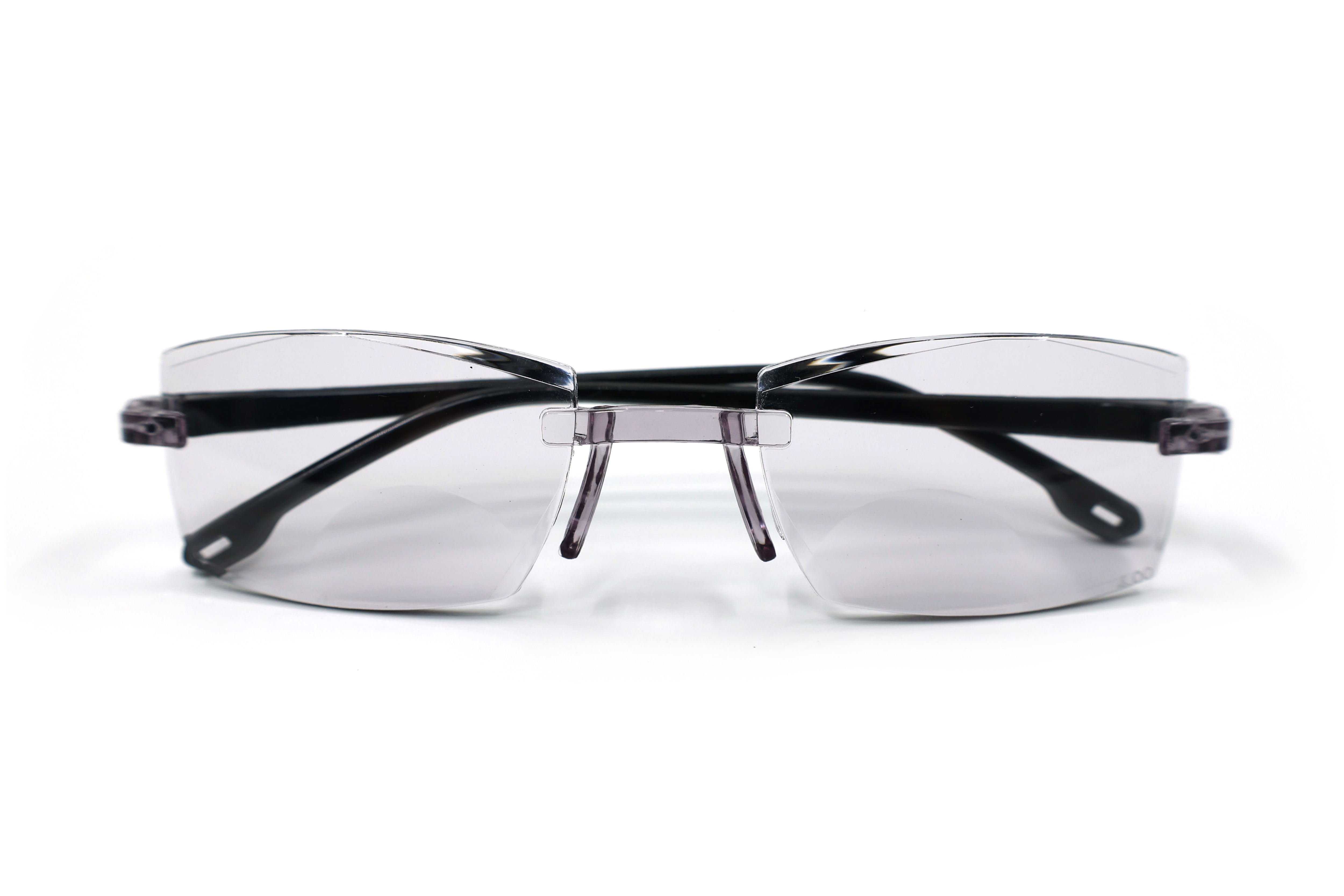
TL;DR
A 16.7 g rimless progressive reader with a genuinely smooth power gradient and built-in blue-light filtering. It removes the glasses-on, glasses-off routine better than anything else in this test. The catch is that it is sold only on the brand's own page, and like all ready-made readers it cannot correct astigmatism.
Who it suits
- Anyone over 45 moving between paper, phone and laptop through the day
- People who find conventional frames leave marks on the nose or ears
- Evening readers who want a blue-light filter without paying extra for it
- Readers who keep losing track of where they put their glasses
Who should skip it
- Anyone whose two eyes need noticeably different strengths
- People with astigmatism, who need a dispensed prescription
- Shoppers who want to try a pair on in a shop before buying
Specifications
| Lens type | Progressive dual focus, no visible line |
|---|---|
| Frame | Rimless, aerospace-grade Japanese AC |
| Weight | 16.7 g |
| Blue light | Blocks 100% of harmful high-energy blue light |
| Lens finish | Scratch-resistant, waterproof, oil-proof |
| Channel | Official Hilipert page only |
Materials and construction
The frame is rimless in the strict sense: the lenses are drilled and mounted directly onto a slim bridge and two temple arms, with no surrounding rim to add mass. Hilipert describes the arm material as the same Japanese AC used in aerospace work, which is the kind of claim that is impossible to audit from a kitchen table, but the behaviour of the material is at least consistent with it. The arms flex a long way before they show any inclination to take a set, and they return straight.
What you can verify is the weight. On a kitchen scale mine came in at just under 17 grams, which matches the stated 16.7 g closely enough. For comparison, a typical acetate drugstore reader runs 25 to 32 grams. That difference does not sound like much written down, and it is the single most consequential thing about this product in practice.
The lens edges are polished rather than left raw, which matters on a rimless design because the edge is visible from the side. The mounting points use a bushing rather than metal directly against the lens, which is the detail that usually determines whether a rimless pair develops a stress crack around the drill hole after a year.
First impressions and the adaptation period
Out of the box the first sensation is that you are holding almost nothing. Put them on and the second sensation, for anyone used to heavier frames, is a slightly disconcerting absence of contact.
The optical adaptation took me about three days. On day one there was mild peripheral swim when turning my head quickly, which is normal for any progressive lens and comes from the unavoidable distortion either side of the central corridor. By day three I had stopped noticing it, mostly because I had unconsciously learned to point my nose at whatever I wanted to read rather than sliding my eyes across.
The transition down the lens is the thing I was most sceptical about and most impressed by. Reading a broadsheet column from headline to footer, I could not catch the text stepping. With a bifocal you feel the boundary; here there is nothing to feel.
How it performs across the day
Morning newspaper at the kitchen table: full reading power at the bottom of the lens, and enough mid-range at eye level that I could hold a conversation across the table without lifting the glasses. This is the scenario where single-strength readers fail most obviously.
Laptop work: the intermediate corridor covers a screen at arm's length adequately, though the sweet spot is a narrower band than on a dispensed progressive with measured pupil positions. Raising the monitor slightly so my gaze drops naturally into the corridor made a bigger difference than any adjustment to the glasses.
Phone at close range and evening reading in bed: no complaints, and the blue-light filter is a mild but noticeable presence on a bright screen in a dark room. The tint is neutral enough that white backgrounds do not look yellow, which is not true of every filtering lens.
Outdoors and driving: these are readers, not distance glasses, and the top of the lens is not intended to sharpen a far-away road sign. I took them off to drive, as you should with any pair.
Evidence and durability
The brand's own material leans on an anecdote about a pair surviving being stepped on. I did not deliberately stand on mine, but I did sit on them once, which with rimless glasses is the usual moment of death. The arms splayed and returned; nothing cracked at the mounting points.
Over two weeks the lenses picked up no visible scratches despite being carried loose in a jacket pocket, which is a harsher test than most people will apply. The stated waterproof and oil-proof coating shows up as fingerprints wiping off cleanly rather than smearing.
The honest limit of this evidence is time. Two weeks tells you about materials and comfort; it tells you nothing about whether the coating survives two years of cleaning with a shirt tail. Anyone claiming otherwise about any pair of glasses is guessing.
Care and longevity
Rinse under lukewarm water before wiping, because most lens scratches are caused by dragging grit across the surface with a dry cloth. Use a microfibre cloth, not paper, and never household glass cleaner, which strips coatings.
With rimless designs, hold the lens rather than the arm when putting them on or taking them off, so the force does not act through the mounting screws. If a screw loosens, a jeweller's screwdriver and a quarter turn fixes it before it becomes a lost lens.
Price and guarantee
The official checkout currently lists one pair at $34.99 against a $54.99 list price and describes this as 36% savings. These figures were checked independently on 11 August 2026.
The page also advertises a money-back guarantee and a free-shipping offer. As with any direct-to-consumer purchase, read the return terms at checkout rather than relying on a summary — including ours — because those terms are the brand's to change.